
Many people claim to follow certain “rules” that guarantee best results when it comes to losing or gaining weight. Some of the rules include no carbs after 6pm, eating protein in the 20 minutes after your gym session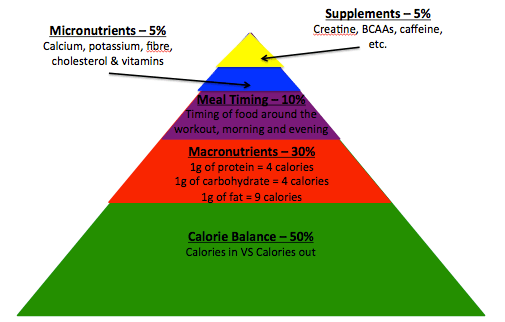 ends (the window of gainz!) or the certain supplement you simply must be taking to make sure you get the most from your food/training. How one particular food will help you bulk or the 3 foods to cut out when trying to get leaner. I keep hearing these crazy theories on how best to “cut” or “bulk”. With so many people now trying to get lean, drop body fat, pack on muscle or whatever the case maybe I thought it best to put this together to help everyone achieve their goals.
In the diagram above I have put together a simple pyramid of what is most important when dieting for changes in body composition (fat loss/muscle gain). This is a combination of work from Eric Helms and Renaissance Periodisation so I can’t take all the credit. The most important factor is at the bottom and each row of the pyramid decreases in importance as you reach the top.
All too often I see people focusing on the top two or three tiers while completely ignoring the bottom row. I see it as the foundation for all other steps and as many of us already know in other aspects of life, without a solid foundation it can all too easily come crashing down. How many times have we seen friends or workmates start extreme diets, nutrition plans or cleanses before coming to an abrupt end.
Most people’s first concerns are from the top of the pyramid. What supplements should I be taking? When are the best times to eat my meals? Will creatine increase my bench press or help get rid of my chicken legs? Will eating carbs near bedtime turn straight to fat? If I don’t “take” protein straight after the gym will I lose the benefit of everything I’ve just done? Do green tea and spicy foods really speed up my metabolism? Which is better, 3 large meals or 6 small meals?
Focusing on the top 10% may yield some results yet it pales in comparison to the huge benefits that will be seen from sorting out simple calorie balance. Everyday we burn a certain number of calories from our general day-to-day activities and any exercise we do. The amount of calories burned differs from person to person and day to day. It differs between people, as we are all different shapes and sizes. It changes in individuals depending on the various activities we get up to such as work and exercise. You may burn slightly more one day than you do the next. That is why all calorie numbers are based on an average for each day across a full week of activities.
We need a certain number of calories each day just to survive. For beginners it doesn’t really matter where these calories come from. If a female (let’s call her Erin) weighs 68kg and needs 1,850 calorie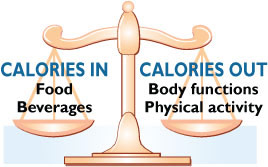 s a day to stay at the same weight then she will remain at that weight if she eats that amount of calories. If Erin starts eating extra food and ends up at 2,000 calories each day then her weight will slowly start to increase. An extra 150 calories a day will result in a very slow weight gain. If Erin is not doing any extra exercise or weight training this will result in her putting on fat. If she is lifting weights then the majority of what she puts on will be muscle, very tiny amounts of muscle.
If Erin starts to do extra exercise every day but stays at 1,850 calories then she will begin to lose weight. If all of this exercise is cardio based then she will lose mainly fat but some muscle as well. If she does weight training or a mixture of weights and cardio then she will lose nearly all fat.
Erin’s best plan would be to eat extra calories everyday and balance this with extra exercise, ideally a combination of weights and cardio. Beginners to weightlifting will notice massive gains in strength in their first year. They are in a great position to lose fat while building muscle. This ends up with no difference on the weighing scales but with clothes fitting much looser, extra energy and a more toned look throughout the whole body. It also leaves for that extra flexibility in your diet to fit in a few treats across the week, because let’s face it, we all need those treats!
Many make the mistake of dropping too many calories when trying to lose weight. This is usually done in combination with extra exercise, most of which is cardio based (running, cross-trainer, exercise bike, etc). We must remember that calories are a measure of energy and not weight. We need a certain number of calories to survive. Without enough we will be left feeling hungry and short of energy. The temptation to reach for the biscuit tin or throw a pizza in the oven when hunger strikes is often too much to resist. That is why I would recommend a very small calorie deficit when trying to lose weight.
We must all remember that any extra weight we are carrying was added over a long period of time, often a few years, and so will take a few months to lose if we are to keep it off long term. In the next few days I will post another blog on where best to get our calories from and what the big difference between “good” and “bad” foods are.
If you have any questions in the meantime please contact me at fhsperformance@gmail.com
 FHS-Performance